Does Learning With Artificial Intelligence Last?
A new research consortium asks what students still know and can do once the Artificial Intelligence tool is taken away, and the answer matters to anyone building it into a course.
What Was Announced
In October 2026, Tina Austin, Project Director of Public Interest Technology Pathways at UCLA, launched the UnBlooms Longitudinal Research Consortium at the Cambridge AI in Education Summit. EdTech Innovation Hub reported on 9 November that, according to Austin, more than 40 institutions in several countries have shown interest in taking part.
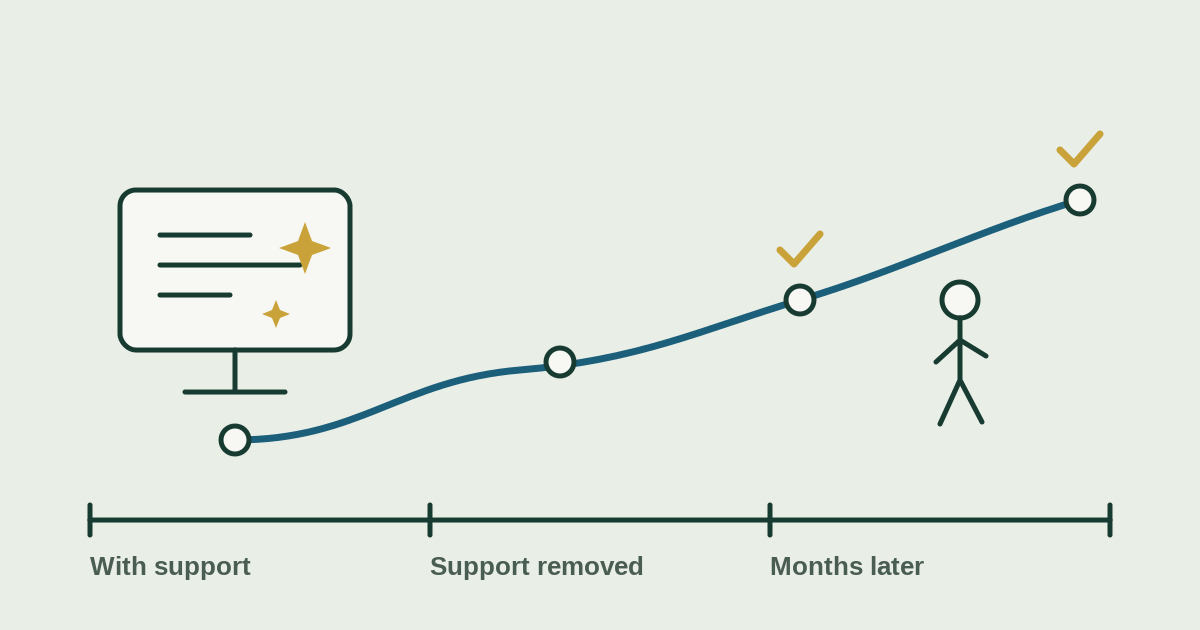
The consortium is built around one plain question. When a student learns with help from Artificial Intelligence, does the learning stay with the student once the help is gone?
The Questions It Will Study
The article lists several lines of enquiry.
- whether learning supported by Artificial Intelligence brings lasting gains in critical thinking, metacognition and independent judgement;
- how those abilities develop when students use Artificial Intelligence again and again, across subjects and settings;
- what students retain when the support is removed, and whether they can still apply what they learned on their own;
- which teaching strategies give lasting learning, how assessment should change, and how to tell a student's own understanding apart from better work produced with the tool.
Why the Long View Matters
A tool that helps a student finish today's assignment does not, by itself, show that the student could manage the next one alone. Better homework and better learning can look the same in a gradebook. Telling them apart means following the same learners over time and checking, at some point, what they can do without the assistant. A longitudinal consortium exists for exactly that kind of work.
The same question sits behind many decisions schools and universities face now. Should an assistant be allowed in coursework? Should an exam be redesigned? Is a pilot worth extending? Each answer depends on evidence about what lasts, and short studies of a single task cannot supply it.
What Is Known So Far
The work draws on the UnBlooms framework and on the Metacognitive Awareness Scale, which is described in a peer-reviewed workshop paper. The article says that paper reports "preliminary shifts" from accepting the output of Artificial Intelligence with little scrutiny towards more active checking and self-critique. Austin also describes promising early experience with her own students and with pilots at other universities, which the article does not name.
She is clear that further validation and longer-term evidence are needed. The article gives no sample size, study design or duration, and names no member institutions, so there are no consortium results to report yet. The consortium has a site at research.unblooms.com.
What Course and Project Teams Can Do Now
Waiting for the consortium is not the only option. Teams that already use Artificial Intelligence in teaching can collect their own evidence, on a small scale, with a few habits.
- Plan a check without the tool. If a course uses an assistant, set at least one later task that students complete without it, and compare it with the work they did with support.
- Measure more than the grade. Short self-report scales on metacognition and confidence, chosen from validated instruments, can sit beside the usual marks.
- Keep the data you will need, and no more. Learning Analytics from the course platform can show when students worked with the assistant and when they worked alone. Decide in advance which records you need, and explain them to students.
- Agree what counts as lasting. Decide before the course starts whether you will look again after a week, at the end of term or a year later, so the comparison is fair.
None of these steps replaces a long, multi-site study. Together they give a course team its own first answer, and a clearer sense of what to ask when the consortium's results arrive.